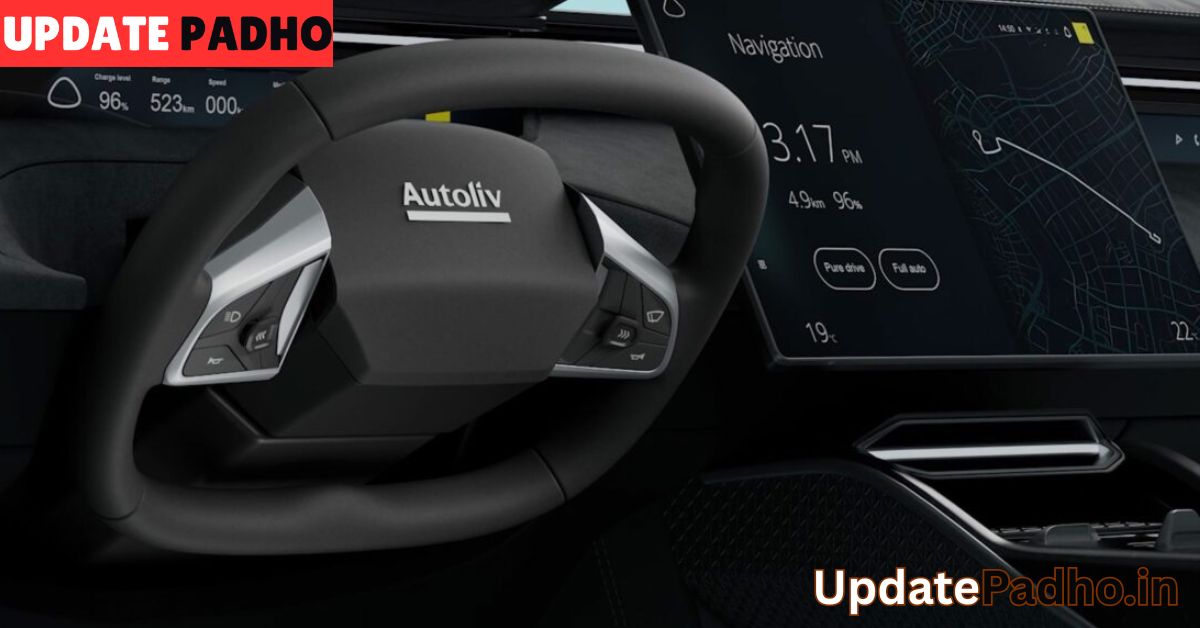
The Automotive industry is undergoing a seismic shift as vehicles transition from driver-centric machines to autonomous mobility platforms. At the forefront of this transformation, Autoliv, a global leader in automotive safety systems, and Tensor, a pioneer in autonomous driving technology, have co-developed the world’s first foldable steering wheel. Announced in January 2026, this innovation addresses one of the most overlooked challenges in autonomous vehicles: how to make interiors more flexible when the steering wheel is no longer always needed.
Why a Foldable Steering Wheel?
In Traditional cars, the steering wheel is a permanent fixture, essential for human control. But in Level 4 autonomous driving, where the vehicle can handle all driving tasks within defined conditions without human intervention, the steering wheel becomes redundant.
- Obstacle in Cabin Design: A static steering wheel limits interior space and restricts design possibilities.
- Passenger Comfort: Autonomous vehicles are envisioned as mobile living spaces, requiring more room for relaxation, work, or entertainment.
- Safety Considerations: A retractable wheel ensures it doesn’t obstruct airbags or other safety systems when not in use.
The foldable steering wheel solves these issues by retracting seamlessly into the dashboard, clearing the driver’s area entirely.

Key Features and Innovations
1. Seamless Integration
- Works in tandem with Tensor Robocar’s autonomous driving system.
- Automatically retracts when the vehicle switches to Level 4 mode.
2. Enhanced Cabin Flexibility
- Frees up space for alternative interior layouts.
- Enables new seating arrangements, entertainment systems, or workspace designs.
3. Safety First
- Developed by Autoliv, ensuring compliance with global safety standards.
- Designed to integrate with airbags and restraint systems without compromise.
4. Human-Centric Design
- In lower autonomy levels (L2/L3), the steering wheel remains accessible for driver control.
- Transition between manual and autonomous modes is smooth and intuitive.
Impact on Autonomous Vehicle Design
Interior Transformation
The foldable steering wheel is a catalyst for rethinking car interiors. Without a permanent wheel, cabins can evolve into:
- Mobile offices with desks and screens.
- Relaxation zones with reclined seating and entertainment systems.
- Family spaces with flexible seating arrangements.
Industry Benchmark
This innovation sets a precedent for other automakers and suppliers, pushing the industry toward modular, adaptive interiors.
Comparison: Traditional vs Foldable Steering Wheel
| Feature | Traditional Steering Wheel | Autoliv-Tensor Foldable Wheel |
|---|---|---|
| Presence in Cabin | Permanent fixture | Retracts in autonomous mode |
| Space Utilization | Limited | Flexible, open cabin |
| Safety Integration | Standard airbags | Optimized with retractable design |
| Autonomy Compatibility | Manual driving only | Supports Level 4 autonomy |
Challenges and Considerations
- Engineering Complexity: Designing a retractable wheel that meets safety standards is technically demanding.
- Consumer Trust: Drivers must feel confident in the transition between manual and autonomous modes.
- Regulatory Approval: Global safety regulators will need to adapt standards for foldable steering systems.
The Road Ahead
Autoliv and Tensor’s foldable steering wheel is more than a novelty—it’s a strategic innovation that aligns with the future of mobility. As autonomous vehicles become mainstream, interior design will play a critical role in consumer acceptance.

This development could inspire:
- Automakers to adopt foldable or modular controls.
- Suppliers to innovate complementary systems like retractable pedals or adaptive dashboards.
- Consumers to embrace autonomous vehicles as comfortable, versatile spaces rather than traditional cars.
Conclusion
The unveiling of the foldable steering wheel by Autoliv and Tensor marks a pivotal moment in the evolution of autonomous vehicles. By combining safety expertise with cutting-edge automation, the two companies have solved a practical challenge that could redefine how we experience mobility.
As cars transition into autonomous living spaces, innovations like this will determine not only how vehicles function but also how they feel. The foldable steering wheel is a symbol of the industry’s shift toward flexibility, comfort, and human-centric design—a future where the steering wheel is no longer a barrier, but an option.