
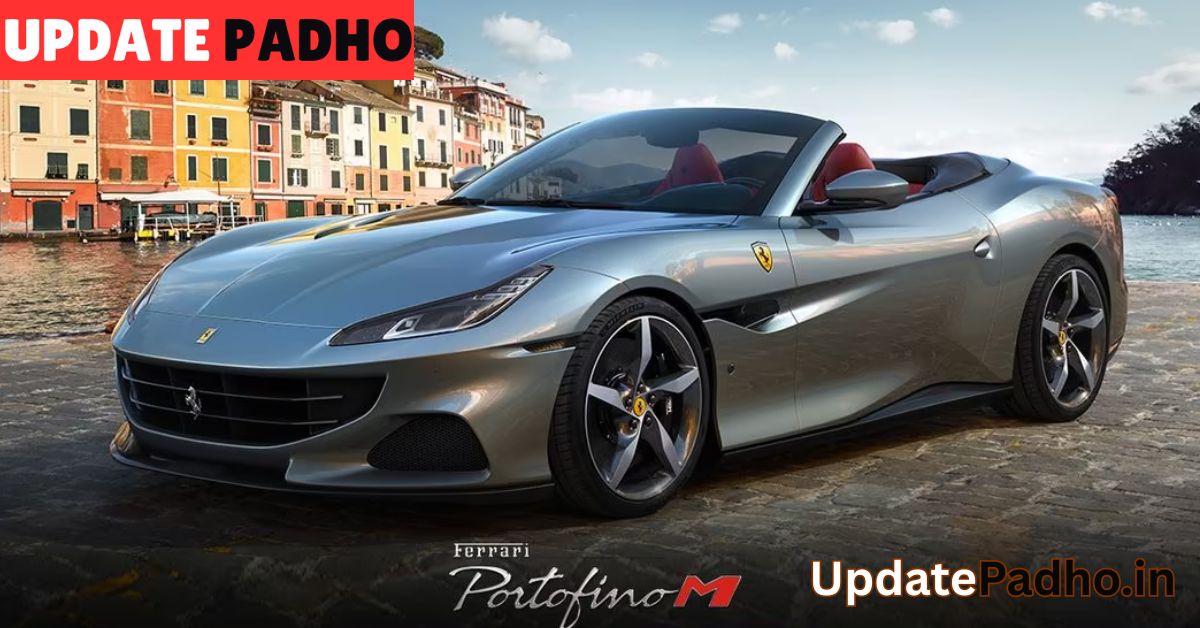
In the high-octane world of Maranello, the “M” suffix—short for Modificata—is a badge of evolution. When the Ferrari Portofino M was unveiled, it was more than just a mid-cycle refresh; it was a refinement of the “daily driver” Ferrari concept. As we look at the automotive landscape in 2026, where the sleek Roma Spider has largely taken the mantle for open-top entry into the brand, the Portofino M stands as a significant milestone: the last of the hardtop V8 Ferraris.
Dual Soul: The Hardtop Advantage
What always separated the Portofino M from its peers was its “Twin Soul” philosophy. Thanks to its Retractable Hard Top (RHT), the car manages a trick that few supercars can pull off convincingly. With the top up, it is a rigid, silent, and aerodynamically sleek coupe. With the press of a button, it transforms in just 14 seconds into a visceral, wind-in-the-hair spider.
While soft-tops have made a comeback for their weight-saving properties, there is an undeniable security and aesthetic “finished-ness” that comes with the Portofino M’s hardtop. In 2026, collectors and enthusiasts are beginning to appreciate this model even more, as Ferrari’s current lineup shifts toward fabric roofs for its front-engine convertibles.

Power Refined: The Modificata Heart
The “M” in the name represents a serious mechanical upgrade. Ferrari took the award-winning 3.9-liter twin-turbo V8 and massaged it to produce 620 cv (612 hp), a 20-hp jump over the original Portofino. This wasn’t just a software tune; new camshaft profiles and a turbine speed sensor allowed the engineers to push the engine’s efficiency further.
Performance at a Glance:
| Metric | Specification |
| Engine | 3.9L V8 Twin-Turbo |
| 0–100 km/h | 3.45 Seconds |
| 0–200 km/h | 9.8 Seconds |
| Top Speed | > 320 km/h (199 mph) |
| Transmission | 8-Speed Dual-Clutch (F1 DCT) |
The addition of the 8-speed gearbox—derived from the SF90 Stradale—transformed the car’s personality. The shorter gear ratios provide explosive acceleration in lower gears, while the eighth gear ensures fuel-sipping (relative to a Ferrari) calm during long-distance highway cruising.
The Driver’s Cockpit: Five-Position Manettino
For the first time in a Ferrari GT spider, the Portofino M introduced the five-position Manettino. Historically, the “Race” mode was reserved for the more aggressive mid-engine supercars. By including it here, Ferrari signaled that the Portofino M wasn’t just for cruising the Amalfi coast—it was ready for a canyon sprint.

The “Race” mode, supported by the Ferrari Dynamic Enhancer (FDE), uses software to adjust brake pressure at the calipers, making the car’s lateral dynamics more predictable and easier to control at the limit. It effectively turns a comfortable grand tourer into a precision instrument.
Interior: Luxury Meets Tech
Inside, the Portofino M is a masterclass in Italian ergonomics. The “Dual Cockpit” architecture ensures the passenger feels as involved as the driver, often featuring a dedicated passenger-side display showing speed and RPM.
The center of the cabin is dominated by a 10.25-inch touchscreen that serves as the hub for infotainment. Despite its supercar performance, Ferrari didn’t skimp on daily comforts. The 18-way adjustable seats feature a “neck warmer” function—essential for those crisp autumn drives with the top down—and the magnesium structure of the seats ensures they are as light as they are supportive.

A Legacy of Versatility
In the rearview mirror of 2026, the Portofino M is remembered as the Ferrari that asked for no compromises. It had the trunk space for a weekend getaway (292 liters), the ground clearance to survive a speed bump, and the reliability of a 7-year maintenance program.
It occupied a unique space where it was “tame” enough to take to a business meeting but “Ferrari” enough to make your heart race at 7,500 RPM. As the brand moves toward a more hybridized and digital future, the analog soul and mechanical brilliance of the Portofino M remain a high-water mark for the front-engine V8 era.