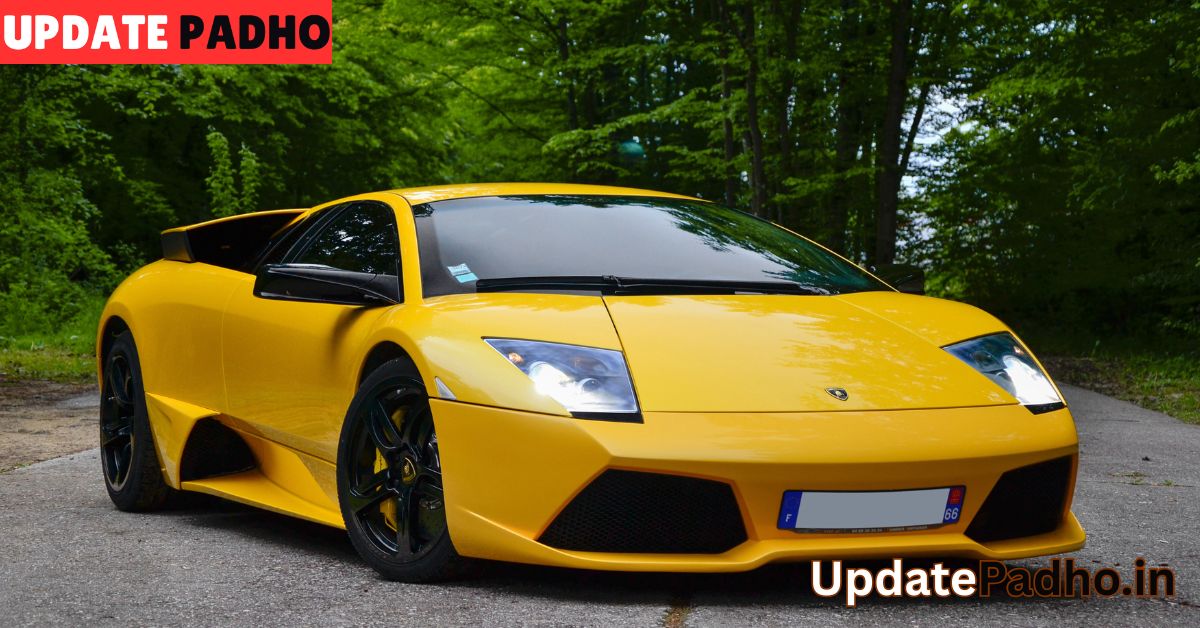
The turn of the millennium was an anxious time for supercar purists. In 1998, Audi officially took the reins of Lamborghini, causing enthusiasts worldwide to hold their collective breath. The fear was palpable: Would corporate German oversight sanitize the beautiful, dangerous, and gloriously unhinged soul of the Italian raging bull?
In 2001, Lamborghini delivered its answer at the Frankfurt Motor Show. It was called the Murciélago.
Named after a legendary Spanish fighting bull that survived 24 sword strokes in an 1879 bout and was spared for its sheer ferocity, the Murciélago did not just preserve Lamborghini’s DNA—it weaponized it. Produced until 2010, this mid-engine icon proved to be the perfect bridge between raw, old-school analog violence and modern engineering precision.
Design: Stealth Fighter Meets Raging Bull
Before the angular lines of the Aventador or the hybrid complexity of the Revuelto, the Murciélago redefined 21st-century exotic design. Penned by Belgian designer Luc Donckerwolke, the car’s profile was a masterclass in geometric tension. It sat less than four feet off the ground, boasting a low-slung, cab-forward silhouette that looked fast even when parked.
The Murciélago brought a theatrical sense of drama that only a flagship Lambo could pull off:

- The Scissor Doors: A hallmark since the Countach, swinging upward to demand attention anywhere it stopped.
- Active Aerodynamics: Famously referred to as its “bat wings,” the electromechanical air intakes integrated into the car’s shoulders would automatically deploy at high speeds to feed air to the engine, completely changing the car’s visual attitude on the fly.
- Carbon Fiber Core: Except for the steel roof and aluminum doors, the majority of the brutalist bodywork was crafted from lightweight carbon fiber.
The Heart: A Symphony of Twelve Cylinders
While its striking looks captured the eyes, it was what lay beneath the glass rear louvers that captured the soul. The original 2001 Murciélago featured a 6.2-liter naturally aspirated V12 engine. This wasn’t just any motor; it was the final, ultimate evolution of the original Lamborghini V12 architecture that traced its lineage all the way back to Giotto Bizzarrini’s design in the 1960s.
In its initial launch, the 6.2-liter engine pushed out a staggering 572 horsepower and 479 lb-ft of torque. Power was routed through a permanent all-wheel-drive system—a first for a standard Lamborghini flagship—splitting power 70% to the rear and 30% to the front via a viscous coupling center differential. It shot from 0 to 60 mph in a blistering 3.8 seconds, rushing onto a top speed of 205 mph.
But it wasn’t just about the numbers. It was about the delivery. Without turbochargers or hybrid batteries to muffle the exhaust note, the Murciélago screamed with a mechanical, metallic howl that could shake your spine at its 7,500 rpm redline.
The Evolution: LP 640 and the Ultimate SV
Lamborghini didn’t rest on its laurels. In 2006, the supercar evolved into the Murciélago LP 640. The engine was stroked out to 6.5 liters, bumping output to 631 horsepower. The 0–60 mph sprint dropped to 3.4 seconds, and the top speed climbed to a terrifying 211 mph.
Then came the grand finale: the 2009 LP 670-4 SuperVeloce (SV).

The SV was a lightweight, track-focused animal. Lamborghini stripped 220 pounds of weight out of the car, added a massive carbon-fiber rear wing, and dialed the V12 up to 661 horsepower. It was raw, uncompromising, and managed 0–60 mph in a physics-defying 2.8 seconds. Only 350 units were ever made, securing its place as an instant blue-chip collector’s Holy Grail.
The Last True Analog Supercar
What truly makes the Murciélago a modern classic is its driver-centric soul. It was the last V12 flagship from Sant’Agata Bolognese to feature a six-speed gated manual transmission.
While many buyers opted for the optional “E-Gear” automated manual paddle shifter, the gated manual cars are the stuff of automotive legend. Sliding the metal shifter through that exposed chrome maze, accompanied by the distinct clack-clack sound, required absolute focus, mechanical empathy, and serious skill.
A Lasting Legacy
When the final Murciélago—an Arancio Atlas LP 670-4 SV—rolled off the assembly line in May 2010 (car number 4,099), it marked the end of an era. It was the last flagship to feature the original Bizzarrini-derived V12 block and the last to offer a clutch pedal.
Today, in a world dominated by silent electric motors, automated driving aids, and turbochargers, the Murciélago stands as a monument to pure automotive theatre. It is loud, intimidating, unapologetic, and completely intoxicating—a true fighting bull that refused to be tamed.